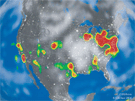
 Example: detecting the nitrogen cycle and the impact of human activity As with meteorology, this requires placing sensors within a social system in order to anticipate and predict its (re)actions. As you will read, studying and collecting information about the target environment—in this case, the social group one seeks to understand or master—is part of a strategy of contact and rapprochement. Or, at the very least, part of an effort to understand and thereby manage environmental risks that may occur.
It is, quite simply, about developing intelligence strategies on environments that are what we call complex systems. It is understood that once intelligence is collected, strategies for environmental control can be designed and implemented.
It is likely that the evolution and levels of complexity reached by systems—especially living systems—will become an increasingly crucial subject of study for humanity. A key domain whose mastery could provide the means for a better understanding of our own evolution.
From this perspective, monitoring and understanding the vectors or variables that shape the destiny of Earth’s biotope and of its evolved forms (humanity or complex systems) could indeed constitute a particularly relevant field of study.
In any case, approaches to complexity levels—and the way exo-civilizations might view the different “infospheres” they encounter—should vary greatly depending on their degree of technological, social, and of course moral evolution.
As a result, their involvement in our environment could vary widely: from complete ignorance, to surveillance, to interference at different degrees. More broadly, the need to monitor our environment and surround it with invisible probes seems to constitute a “minimal” precaution.
Collecting information to build predictive models of the complex systems in which we are immersed should be of interest both to hypothetical advanced civilizations—and, increasingly, to humans.
Under the hypothesis that deploying and then monitoring sensors, probes and information-collection means could constitute a research project capable of generating “exotic” activity, we seek to test the following idea:
| H1: is an “intelligent” exogenous manifestation correlated with the main variables likely to significantly impact our biosphere—i.e., does it track the variables likely to call into question the evolution of the levels of complexity achieved on Earth? |
Which can be reformulated more narrowly as follows:
| H1': could this “intelligent” exogenous manifestation correspond to certain “unidentified flying phenomena”? (OVNIs, UFOs, UAPs...) |
To test this hypothesis, we propose to search, within databases of unexplained phenomena, for correlations with environmental parameters that have a major influence on the stability of our biosphere.
Below, click on the link—not on the thumbnail:
Beyond surveillance: control?
A hypothesis that would be compatible and coherent with the surveillance scenario.
| 


